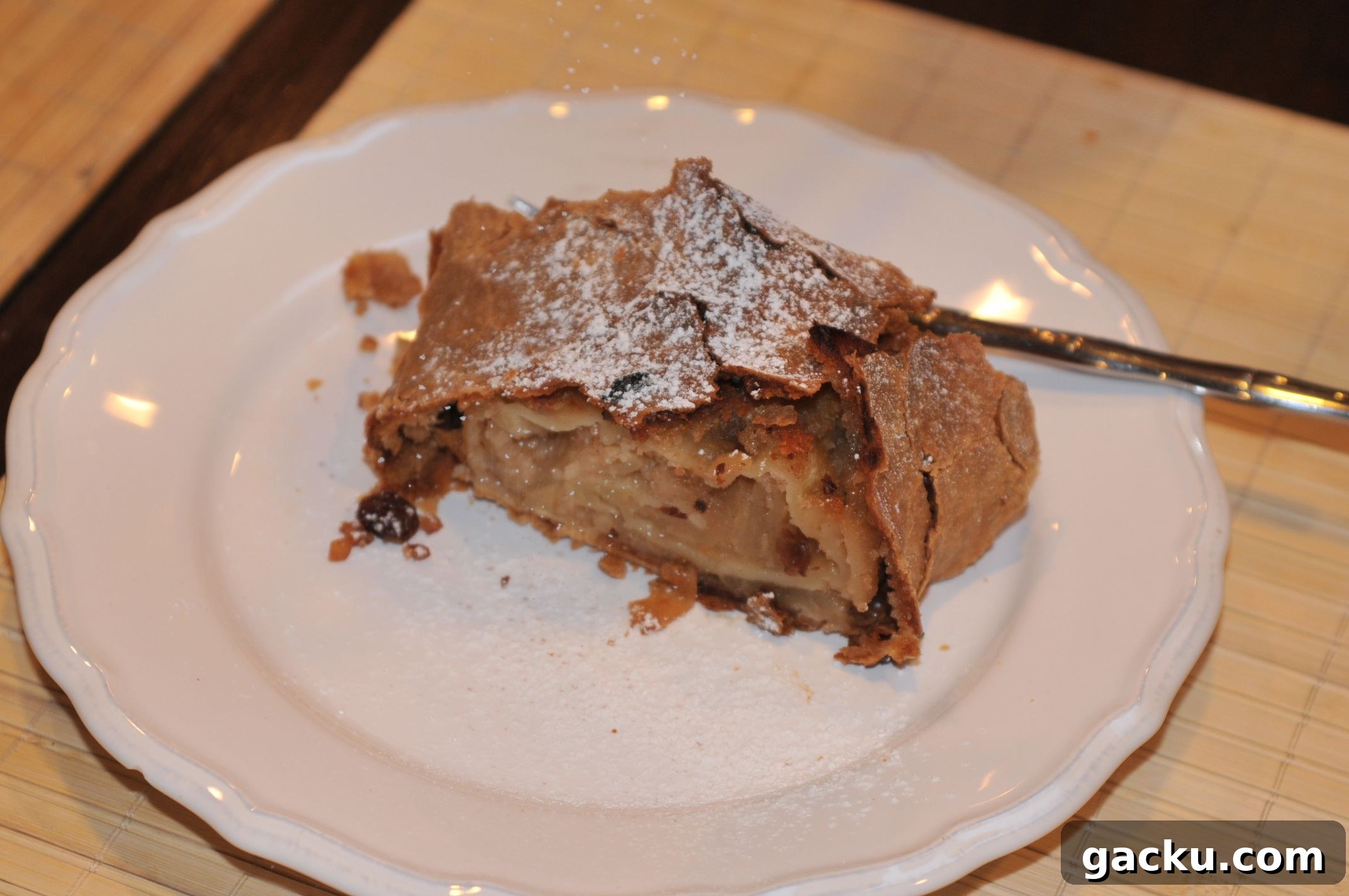
Have you ever wondered how to make an authentic apple strudel? Perhaps you tasted Apfelstrudel while visiting Germany or Austria, or you enjoyed a homemade slice of this delightful pastry that traces its roots to Central Europe. This traditional German-style apple strudel recipe reflects the old imperial technique used in Austria. The classic strudel dough is stretched so thin that, according to tradition, you should be able to read a letter through it — a skill that takes some practice.
When you see a strudel made from store-bought filo (phyllo) dough, know that it is a convenient variation but not the original version. Frozen versions sold in supermarkets are often too sweet and lack the delicate balance of the homemade pastry described here. Classic strudel can also be made with other fillings: cherries, a creamy Rahmstrudel (filled with sweet or sour cream and milk), or Topfenstrudel, filled with curd cheese (quark).
Serve apple strudel warm with vanilla sauce, vanilla ice cream, or a dollop of whipped cream. Happy baking!
Ingredients — Authentic Apple Strudel
For the dough:
250 g all-purpose flour
A pinch of salt
1 egg
20 g butter
Warm water, as needed
For the filling:
1.5 kg apples
80 g plain breadcrumbs (dry, unseasoned)
125 g sugar
65 g raisins
65 g chopped or ground almonds
1 package vanilla sugar (or equivalent homemade vanilla sugar)
Cinnamon to taste
40 g butter
1 tbsp lemon zest (organic preferred)
125–130 ml heavy cream
A smooth, firm surface or baking board for preparing and stretching the dough
Baking Instructions — Apple Strudel
1. On a clean, smooth surface, pile the flour and make a well in the center. Add the egg, butter, salt, and enough warm water to form an elastic, smooth dough. Knead for about 5–10 minutes until pliable and even. Cover the dough with a kitchen cloth and let it rest for 20 minutes.
2. Prepare the filling: peel, core, and finely slice or chop the apples. Soak the raisins briefly in hot water to plump, then drain. Mix the apples with breadcrumbs, sugar, vanilla sugar, almonds, cinnamon, raisins, and lemon zest. Set aside.
3. Dust the baking board or a large kitchen cloth with flour. Roll out the rested dough, then carefully stretch it outward from the center until it becomes uniformly thin and nearly translucent. The traditional ideal is very thin dough, almost see-through; trim any thick edges with scissors.
4. Brush the stretched dough with a thin layer of cream, leaving a margin at the edges. Spread the apple mixture evenly over the dough, avoiding overfilling.
5. Starting from one long side, gently roll the dough into a log, tucking in the ends to seal. Transfer the strudel to a greased baking tray or a tray lined with parchment paper. If the strudel is longer than the tray, arrange it in a U-shape to fit.
6. Preheat the oven to 210–220 °C (about 400 °F). Place the strudel in the oven and bake for 60–70 minutes. During baking, brush the pastry occasionally with melted butter to develop a golden, crisp crust.
7. Remove from the oven and let the strudel rest briefly. Serve warm with whipped cream, vanilla sauce, or vanilla ice cream and a cup of coffee.
Tips
– Use a clean kitchen cloth when rolling and stretching the dough to help achieve the thin, even sheet.
– Consider baking the strudel in a deep, ovenproof roasting pan rather than a flat tray to catch any juices if the pastry cracks. A higher-sided pan prevents spills.
– The less fat incorporated into the dough, the easier it is to stretch very thin.
– If needed, wrap the baked strudel loosely with aluminum foil while it rests, leaving the top partially uncovered so the crust remains crisp.