Are you torn between buying a pellet grill or a charcoal grill? This guide from TheGrillingDad breaks down the differences so you can choose the right grill for your needs.
In this guide you will find:
- Key differences between pellet and charcoal grills
- Which grill suits different cooking styles and lifestyles
- Pros and cons of each type
- Practical recommendations to help you decide
Jump to Section
Pellet Grill vs. Charcoal Grill Overview
Choosing the right grill starts with understanding how you plan to cook outdoors. Pellet and charcoal grills excel at different styles: pellet grills are versatile and excel at low-and-slow smoking and consistent temperature control, while charcoal grills are prized for high-heat searing and portability.
If you need portability for tailgating, camping, or moving the grill around, a charcoal grill is usually the better option. If you want versatility—roasting, baking, smoking, and steady grill temps—a pellet grill can offer more functions, though it requires electricity.
Read on for a breakdown of how each grill works, plus pros and cons to help you decide.
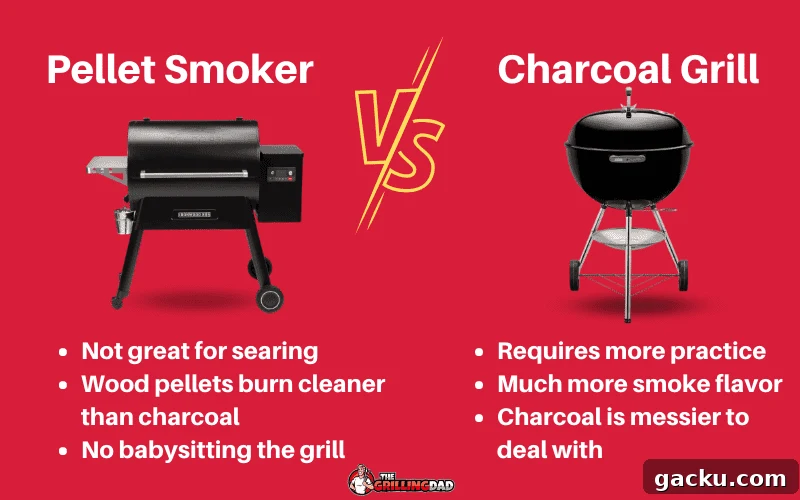
Pellet Grill and Charcoal Grill At a Glance
Your final decision should reflect how you cook, where you grill, and how much effort you want to spend learning and maintaining the grill. Below are concise snapshots of each type to make that comparison easier.
Pellet Grill At a Glance
Pellet grills run on electricity and use wood pellets made from compressed sawdust to generate heat and smoke. An electric auger feeds pellets into a firebox where they combust, while digital controls maintain temperature. Pellet grills are known for their ability to grill, smoke, bake, roast, and more, offering considerable versatility.
Pros:
- Larger cooking areas on many models
- Easy to operate—set it and let it run
- Good for long cooks and consistent low-and-slow smoking
- Produces a pleasant smoky flavor
- Stable temperature control during cooks
Cons:
- Requires a nearby electrical outlet
- Some models struggle to reach very high grilling temps
- More parts to clean and maintain
- Generally higher upfront cost and more maintenance
Best for: backyard cooks who want versatility and reliable temperature control, especially for smoking and slow roasting.
Charcoal Grill At a Glance
Charcoal grills do not require electricity and are fueled by briquettes or lump charcoal, making them portable and straightforward to use. They are favored for the high heat they can deliver, which is ideal for searing and fast cooks.
Pros:
- Excellent for high-heat searing
- Cooks quickly at high temperatures
- Simple to operate once you master the technique
- Easy to clean—remove ash and you’re done
- Fuel is widely available and inexpensive
Cons:
- Smaller cooking areas on many models
- Requires more hands-on temperature management
- Learning curve to dial in the right charcoal amount and airflow
- Fewer built-in features or digital controls
- Needs regular deep cleaning of ash and residue
Best for: people who want simplicity, portability, high-heat searing, and lower upfront cost.
Comparison Between the Pellet Grill and Charcoal Grill
Below are key features to compare when deciding which grill to buy. Your priorities—cost, temperature control, portability, maintenance—will determine which model suits you best.
Ease of Use
Pellet grills are easy to start: fill the hopper, plug in, and set the temperature. They maintain heat automatically, letting you step away without constant monitoring. Charcoal grills require lighting and adjusting vents to manage heat, and they typically need more attention during cooking. If convenience is important, pellet grills have the edge.
Cost Comparisons
Pellet grills usually cost more up front because of electronic controls and additional features. Charcoal grills are generally much cheaper to buy and operate, with inexpensive and widely available fuel. If budget is your main concern, charcoal is the more affordable choice.
Temperature Control
Pellet grills offer precise, digital temperature control thanks to their electrical systems, making consistent cooks easier. Charcoal grills require manual control of airflow and fuel, which takes practice. For consistent temperature and hands-off cooking, pellet grills win.
Temperature Range
Pellet grills excel at low-and-slow cooking and usually top out around 400°F on many models, though some reach higher. Charcoal grills can reach very high temperatures—often 600°F to 700°F—ideal for searing and fast cooks. The best choice depends on whether you prefer low-and-slow smoking or high-heat grilling.
Regular Maintenance
Pellet grills require periodic cleaning of the firebox and hopper area, and occasional vacuuming to remove ash buildup. Charcoal grills have simpler maintenance: remove ash and brush grates. On maintenance alone, charcoal grills are easier to care for.
Fuel Costs
Wood pellets are typically more expensive and sometimes harder to source than charcoal briquettes or lump charcoal. Charcoal is inexpensive and widely available, making ongoing fuel costs lower for charcoal grills.
Portability
Pellet grills are usually larger and require electricity, limiting portability. Charcoal grills are compact and easy to transport, making them better for tailgating, camping, or moving around the yard.
Pellet Grill vs. Charcoal Grill: The Winner
There’s no single “best” grill for everyone. According to the features compared here—cost, maintenance, portability, fuel availability, and high-heat performance—the charcoal grill often comes out ahead for value, portability, and simplicity. However, pellet grills remain a top choice for cooks who want versatility, precise temperature control, and the convenience of setting and walking away during longer cooks.
Choose a charcoal grill if you want high heat, easy maintenance, low ongoing costs, and portability. Choose a pellet grill if you value versatility, consistent temperatures, and the ability to smoke, roast, and bake with minimal monitoring.
No matter which type you pick, both grills can deliver excellent results. Pick the one that best matches how you like to cook and where you plan to use it, and you’ll be set up for many delicious meals.